
Anatomy of the Anglican Rosary
A Close Look at What Makes the Anglican Rosary
As has been mentioned in previous posts, we have a fondness here at Thin Place Trails for the

Anglican Rosary. The Anglican Rosary, also known as The Protestant Rosary, Anglican Prayer Beads, or Protestant Prayer Beads is a relatively new addition to the family of prayer beads/ropes and because of this there are a lot of opportunities to mold it to fit the practice that best suits the individual through their journey on the Thin Place Trail. First, we’ll look at the anatomy of the Anglican Rosary and then give a simple prayer system to utilize with them.
We start with the Cross, the beginning and end of the Rosary. If you have one of the Rosaries that are offered at Thin Place Trails the Cross is always a Celtic Cross which is a nod to both the heritage of the Anglican Church as well as the heritage and culture that we try to embrace upon the Thin Place Trail. Just as the Lord welcomes us into new life so too does the Cross welcome us into prayer.

Above the Cross on the stem is the Invitatory/Dismissal bead (depending on whether we are initiating or ending our prayer practice, respectively. This bead invites us into the prayer and later invites us to exit the practice. We are invited here to notice our spirit, our emotions, thoughts, and sensations. Taking them with us through our prayers and then back into the world.
Next comes the first of four Cruciform beads. These four beads form an invisible cross in the center of the Rosary and there is so much symbolism within these four beads. Four has often been utilized to represent the physical Earth tied into the four cardinal directions (North, East, South, and West) as well as the four natural seasons (Spring, Summer, Autumn, and Winter). There was a four-fold witness to the ministry of Christ as accounted in the Four Gospel of Saints Matthew, Mark, Luke, and John. And throughout the Holy Bible we see four being utilized many times in imagery; the four winds of heaven, four rivers flowing out of Eden, as well as the four living creatures described by Ezekiel and in Revelation. These four beads forming a Cross remind us that Christ is the center of all, He was and is the intersection of Divine and human relationships. When praying with this Rosary we pray the cruciforms a total of five times reminding us of the wounds Christ received; two wounds on the hands (or wrists) and two wounds on the feet all from nails as well as the wound in His side from the Roman soldier’s lance.
The last unique element to the Anglican Rosary are the groups of seven beads called weeks. Seven has represented completeness, spiritual perfection, and divine fullness. First, the account of creation gives us seven days. Rituals and actions were completed in sets of seven; the Israelites were commanded to march around Jericho seven times, Naaman bathed in the River Jordan a total of seven times, and even blood was sprinkled seven times in the tabernacle. The Book of Revelation probably holds the most accounts of seven being an important number; there were seven churches, seven gold lampstands, seven seals, seven trumpets, and seven bowls of judgement. If the number four symbolized the physical Earth and the number three represents the Divine (the Holy Trinity for example) then the number seven represents the union of the physical and the Divine.
Praying with the Anglican Rosary
Obviously there was a lot of thought put into the development of the Anglican Rosary which has developed into a beautiful system. However, all of that thought and that beauty is meaningless if we don’t engage with it as a tool for our pilgrimage along the Thin Place Trail. “Traditionally” when praying with the Anglican Rosary each unique element has a different prayer that goes with it.
To start, find a quiet place and allow your body and mind to become restful and still. After a time of
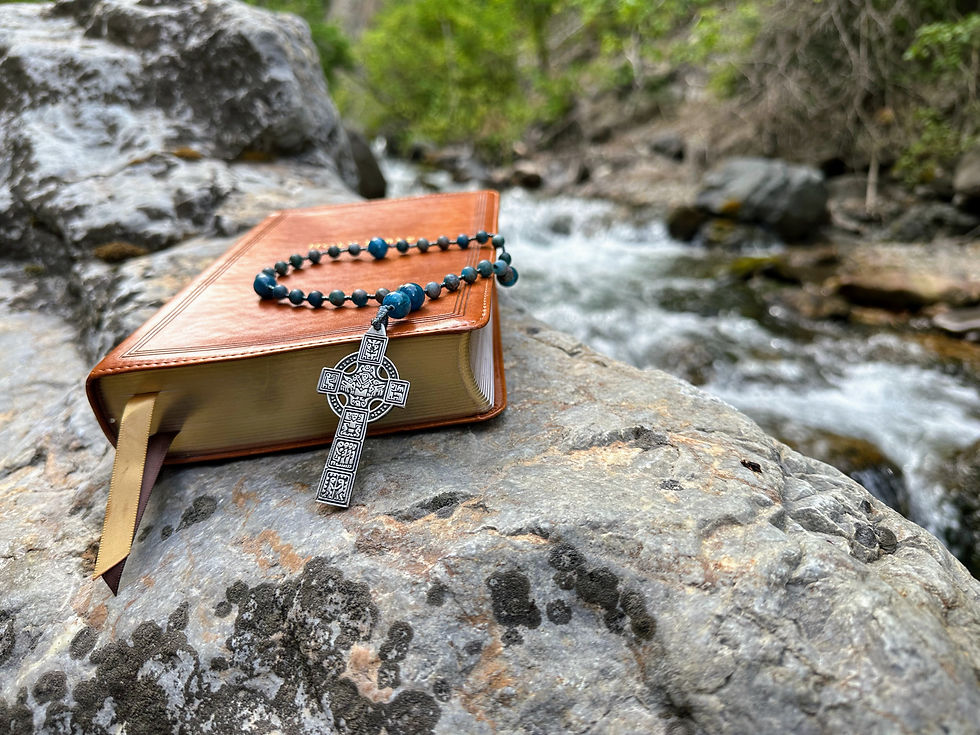
silence, begin praying the Rosary at an unhurried, intentional pace. 1) Start with the Cross and say it’s associated prayer, 2) move to the Invitatory/Dismissal bead and say its associated prayer, 3) move to the first Cruciform bead and say the associated prayer for the cruciform beads, 4) move to the first set of Week beads, at each bead say the associated prayer for these beads, 5) repeat steps 3 and 4 until you move completely around the circle, 6) at the Cruciform bead that you started with repeat the associated prayer one more time, 7) move back to the Invitatory/Dismissal bead and say its associated prayer (many times it is different depending on whether you are praying it as an invitatory or a dismissal, and 8) return to the Cross, saying the associated prayer (many times it is a different prayer than when you started at the Cross).
What Prayers to Use?

As mentioned before, one of the beautiful things about the Anglican Rosary is the fact that it is a newer practice within the family of Prayer Bead/Rope practices. Because of this there is no set prayers for each bead like we find in the Catholic Rosary or the Orthodox Prayer Ropes and we can build a system as simple or as complex as we want. Some choose to change the prayers weekly to go along with the readings associated with the week found in any lectionary, some change the prayers depending on the liturgical seasons, some find the prayers that work for them and stick with those prayers forever. Some change the number of times they pray around the circle, some choose to pray the entire system once and go on while others might choose to go around the circle three times, skipping the very last Cruciform bead which totals one hundred prayers which is the same number of prayers said with the most common Orthodox Prayer Rope. There is no right or wrong way to utilize the Anglican Rosary. The key is to find the system that works best for you and then meaningfully engage with it.
On the first Sunday of every month we will post a new prayer set. This will give a month’s use with the set of prayers before being introduced to a new one. Take what is given, search for others, mix and match pieces together, create your own using all as fuel for your own creativity. Again there is no right or wrong. We have found, though, that using prayers that you can memorize and then sticking with those ones for a prolonged period removes a lot of the friction in using Prayer Beads.
Friction comes when we are working with too many things at once. When learning new prayers for each bead type we tend to focus on just words of the prayers and making sure that we get them right. First off, no one cares if you did it “right” but by focusing on just getting the words right we don’t allow our minds to get over themselves and we never get to a depth where the prayers and the beads become contemplative tools along the Thin Place Trail. As we say the same prayers over and over again the words become rote and our brain is able to give space for contemplative work. This is the ultimate goal of utilizing Prayer Beads, creating space for God to work within us. This is why we will only introduce a new prayer set once a month. This gives enough time to work through the prayers and create that space.
The Centurion’s Rosary
With that all being said, we will now introduce our first prayer sets, which if you search even just a little bit you’ll find is a mashup of a few different prayers already in use in different prayer systems or from different liturgical works. This set we call The Centurion’s Rosary which has a very penitential flow to it that might seem off-putting at first but upon deeper introspection hopefully we find that our only Hope is through Christ.
The Cross (The Apostles’ Creed): I believe in God, the Father almighty creator of heaven and earth and in Jesus Christ, His only Son, our Lord, who was conceived by the Holy Spirit, born of the Virgin Mary, suffered under Pontius Pilate, was crucified, died, and was buried. He descended into hell. On the third day he rose again from the dead. He ascended into heaven and is seated at the right hand of God, the Father almighty; from there he will come to judge the living and the dead. I believe in the Holy Spirit, the Holy catholic Church, the communion of saints, the forgiveness of sins, the resurrection of the body, and the life everlasting. Amen.
The Invitatory Bead (adapted from The Confiteor): I confess to almighty God that I have greatly sinned, in my thoughts and in my words, in what I have done and in what I have failed to do through my most grievous fault. Therefore, O Christ, lead me again upon Your holy path. Wash me in Your mercy, renew me by Your Spirit, and grant that this day I may walk with You in faith, hope, and love. Amen.
The Cruciform Beads (The Centurion Prayer): Lord, I am not worthy that you should enter under my roof, but only say the word and my soul shall be healed.
The Week Beads (The Jesus Prayer): Lord Jesus Christ, Son of God, have mercy on me, a sinner.
The Dismissal Bead (The Trisagion): Holy God, Holy and Mighty, Holy Immortal One, Have mercy upon us.
The Cross (The Glory Be): Glory be to the Father, and to the Son, and to the Holy Spirit. As it was in the beginning, is now, and ever shall be, world without end. Amen.

Whether you pray these words exactly as they are written or adapt them into a rhythm that becomes
your own, remember that the Anglican Rosary is not an end in itself. The beads are simply companions along the trail; guiding your hands while your heart learns to rest in the presence of Christ. In time, the prayers become familiar, the movement becomes natural, and the silence between the words begins to speak as loudly as the words themselves. This is the invitation of the Thin Place Trail: not merely to say prayers, but to become a people of prayer; returning again and again to the One who welcomes us, transforms us, and sends us back into the world to walk in faith, hope, and love.

Comments