
Trail Guide to Walking Ancient Paths: An Introduction to Celtic Christian Spirituality
Trailhead: An Invitation to Walk

One of my favorite pastimes is to go fly-fishing. The cool mountain stream flowing through a canyon carved over millenia, rushing over boulders and cutting into the soft bank. Trees hang over the water, branches full of leaves color the streaming sunlight a beautiful shade of green. The rod, line, and fly become a natural extension of the body as you try to place the fly correctly to lure a hungry trout to take a bite. Often I find myself just sitting on a boulder in the middle of the creek, hearing the running water as it continues its journey down stream, the wind rustling the leaves in the trees, seeing the mosaic of colors, feeling the cool water running over my legs, smelling the mix of dirt with plants. One occasion sticks out more than any other, my son had learned to fly fish and while I was sitting on a boulder in the middle of the stream, watching him cast in the early morning sun; time slowed down, every sense became heightened but at the same time blurred together into one sense, I felt connected to every sense and every moment in that short time frame. I felt an awe and appreciation for the creation that was right in front of me, I felt connected to it and yet apart from it. The overwhelming feeling in that fleeting moment was calm and joy. It was the sense that God was somehow closer. This is what the ancient Celts called a Thin Place-places where heaven and earth seem only a whisper apart.
Thin Place Trails exists to help people cultivate the awareness that I had in that moment every single day. This isn’t about escaping ordinary life rather it is about discovering God IN ordinary life. Before we begin walking these trails together, it helps to understand the tradition that inspires them.
Trail Marker I: What is Celtic Christianity?

Celtic Christianity is simply Christianity lived within the culture of the Celtic people. It is deeply rooted in historic Christian orthodoxy. Christianity was introduced to Celtic peoples during the 3rd and 4th centuries in Roman controlled Britain and spread from there to the people of Gaul. During the 5th century St. Patrick returned to Ireland and began the work of converting the Irish Celts, it was also during this time period that Rome withdrew from Britain and a monastic focused Celtic Christianity began to flourish. During the 6th century Irish missionaries, such as St. Columba expanded the faith into Scotland.
We see that by the 6th century Christianity had been introduced throughout the Celtic world. With the withdrawal of the Roman empire, and its further collapse in the West, Christianity among the Celts became somewhat insulated from continental Christianity and many traditions and practices sprung up amid these people. It must be noted that they were not “cut-off” from the rest of Christendom but just as languages become regional dialects through limited interactions with the outside world so too do other practices, faith being one of them. Some of these practices and traditions that became central to Celtic Christianity include:
Focus on monasticism. Instead of city-centric bishops and diocese being the central place of worship and ecclesiastical authority it was the abbeys and their abbots that was the practical ecclesiastical authority.
Divergent traditions. Celtic Christians had a unique way to calculate Easter which deviated from mainland practices. As well, a unique monastic tonsure (classical monk haircut essentially) marked Celtic monastics differently than their mainland counterparts.
Cultural Integration. Celtic churches had a different view of penitential rites, heavily adopting private confessions. There was a heavy emphasis on the reverential outlook towards the natural world that was pervasive in Celtic culture. This all culminates in an idea called “green martyrdom” which hopes for a spiritual death to one’s old self in the absence of physical persecution.
Celtic Christianity is simply Christianity lived within the culture of the Celtic peoples. Our goal is to not romanticize it or make it into something that it never was. Rather we want to embrace what Christianity entailed through a Celtic lens.
Trail Marker II: More than Myths and Mist
As stated above Celtic Christianity is simply Christianity lived within the culture of the Celtic

peoples. Celtic Christianity is not nature worship. There is a very high appreciation for the natural world within Celtic Christianity but it is not worship, it is an awareness and appreciation that nature is sacramental. It is viewing nature, creation itself, as a means by which God teaches, reminds, comforts, and draws us into communion with Him.
Celtic Christianity is not paganism with Christian language. It is not Celtic myths blanketed with a Christian motif. Celtic Christianity is Christianity blanketed with a Celtic motif. As the church migrated across the continent of Europe and reached the Celts the people and culture were converted by the gospel. They did not stop being Celtic when they embraced the gospel, instead they reflected their new faith through Celtic art, poetry, music, storytelling, and love of the natural world.
Rather than thinking of Celtic Christianity as an intuitive mysticism unconstrained by doctrine, it is better understood as a deeply contemplative spirituality rooted in Scripture and centered on Christ. It is not new age Christianity where mysticism is detached from Scripture and the Gospel, rather it is contemplation shaped by the Bible. It is not magic or romantic fantasy, it is deeply rooted in Christ and His Gospel.
Trail Marker III: Seeing the World as Sacred
One of the defining characteristics of Celtic Christianity is that creation reveals God’s glory.
Psalms chapter twenty four, verses one and two explain this beautifully:

The earth is the Lord’s, and the fulness thereof; the world, and they that dwell therein. For he hath founded it upon the seas, and established it upon the floods.
Or maybe Romans chapter one, verse twenty-four:
For the invisible things of Him from the creation of the world are clearly seen, being understood by the things that are made, even His eternal power and Godhead; so that they are without excuse:
We don’t need to travel to ancient abbeys to encounter God, no we can encounter Him around the kitchen table, walking a trail, in the backyard, during our daily commute. Because Creation reveals God’s glory we can experience that glory everywhere and every-when.
Every ordinary task can become worship in and of themselves once we view the very world as sacred. Meals become holy as we appreciate the Creation that gave us that meal. Good work becomes worship as we engage in bettering the human condition. Rest becomes sacred as we reflect and enjoy the good work that we are engaged in. Pilgrimage no longer becomes an act of piety but rather an act of worship as we find those sacred sites throughout the world. Every moment, every act, every place can become Thin Places.
Trail Marker IV: What is a Thin Place?

Within Celtic tradition Thin Places were places where the space between the material and the spiritual realms was thin. It was “the gods are closer here…” or “we can feel the realm of the faeries closer here…” as Christianity became the faith of these lands that outlook shifted a bit. Rather, it became “a thin place is somewhere OUR awareness of God’s presence becomes clearer”. Because the outlook of creation took upon itself a sacramental vision, suddenly it was clear that God’s presence was always there; we just became more aware of that very presence.
Whether it was on the mountaintops, within the deep glades of the forest, perhaps it was in the pews of the church, all of these became thin places because all of these places contain the presence of God. God’s presence became discernible in retreats from the common, in prayer corners, and just quiet mornings. A Thin Place is where our awareness of God’s presence becomes clearer. Eventually, with practice our entire lives become Thin Places.
It’s not magic, it’s ground mysticism built upon a foundation of belief that the world is sacramental and that we have the grace to experience that sacrament.
Trail Marker V: The Celtic Path of Formation
To be in God’s presence is to be with God. This is the goal and heart of Celtic Christianity that we have at Thin Place Trails. St. John Vianney said something similar when discussing contemplative prayer (a necessary practice along the Thin Place Trail). He said,
“I look at God and God looks at me.”
This is an intimate experience! When we have the opportunity to be in the presence of God we have the opportunity to look at Him as He looks back at us. By tuning ourselves to see and recognize these Thin Places we tune ourselves to be ready to experience God. This is what Christian formation is, tuning ourselves to be in harmony with God by becoming more like Christ. It’s not information, though that is important, but it is action. It is placing ourselves on the potter’s wheel to be formed in the image of Christ.

This is done through a threefold framework. The first of these is orthodoxy. It is critical to formation that we believe rightly. That is why it is important to understand that Celtic Christianity is NOT a different Christianity but rather Christianity as viewed through the lens of Celtic culture and practices. It is knowing the story of scriptures and how that formed the historic Christian faith.
The second is orthopathy. This is loving rightly. We are always learning the heart of Christ and as we do so we order our desires towards God. Christ speaks of this as accounted in the Gospel of Matthew Chapter six, verse twenty-one:
For where your treasure is, there will your heart be also.
As we order our desires, our treasures, towards God our heart inherently must turn towards God as well. This is more than just earthly desires, but really focuses in on our emotional desires. These we fix towards God.
The third is orthopraxy. This is what we do, it is living rightly, practicing obedience, serving others. It is walking faithfully through all of life. It is a welcoming door to friends, it is a meal shared with others, it is a heartfelt “I’m sorry, what can I do to help?”
The three can be likened unto parts of the body. Orthodox is the head, orthopathy is the heart, and orthopraxy is the hands. Thin Places become more discernible as we undertake a clear understanding and acting in accordance within this framework of formation.
Trail Marker VI: The Practices That Shape Us
Spiritual disciplines are those actions that we undertake within the framework of formation to become formed in Christ. This is just a short list of some practices that help form us in the image of Christ. This list is not exhaustive and over time we will look at them more in depth. Some of these practices are:

Daily prayer
Reading the scriptures and meditating on them
Silence
Solitude
Pilgrimage
Keeping the Sabbath
Hospitality
Simplicity
Blessing
Confession
Gratitude
There have been tomes written on all of these practices. But they take on a new meaning and a new importance as we tread the Thin Place Trail. These practices become essentially necessary to learning how to experience these Thin Places. These practices, and others like them, do not earn God’s love, they do not purchase a one time Thin Place experience, no, they create space for God’s transforming work in us. As we become transformed we begin to take on the form of Christ. As we begin to take on the form of Christ we suddenly, honestly, see that God is always with us, always loving us, always welcoming us into His presence.
Trail Marker VII: Why Thin Place Trails?

Thin Place Trails exists to help people experience Thin Places. We have had the opportunity to experience these moments and places and they continue to shape our lives as we try to walk with Jesus daily. We are not experts, rather we are just ordinary people who want to help other ordinary people. We want to recover ancient Christian practices, specifically those practices that were shaped through the lens of Celtic culture and tradition. This mission is about living intentionally, slowing down, and discovering God in everyday life.
Over time we want to make available a log of resources that everyone can use in their personal lives to encounter these Thin Places. As we encounter Thin Places we want others to experience the same. Everything serves one purpose, formation into Christ. Formation into God’s presence.
Campfire Reflection
The Celtic Christians believed every journey toward Christ begins with a single faithful step.
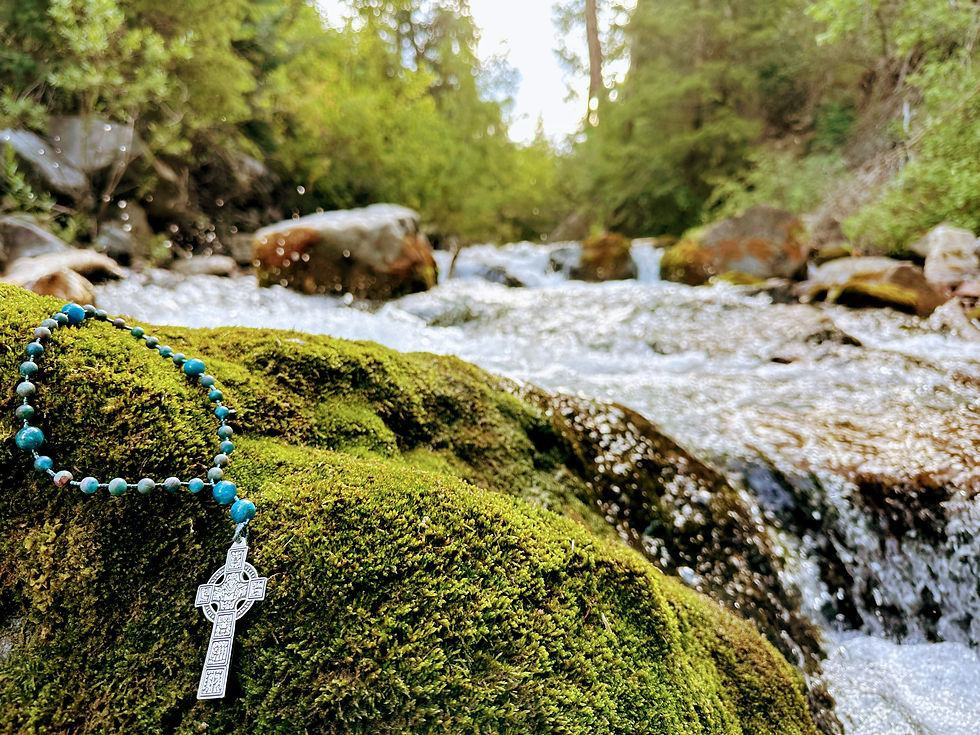
They believed that every journey toward Christ created Thin Places where we could encounter God as the veil between the material and spiritual became thin. You don’t need to move to a monastery. You don’t need to climb a mountain. You don’t need to travel to Ireland, Scotland, or any other Celtic nation. You only need to begin paying attention! God has always been near.
One morning I was taking my daughter to a friend's house. As I got into the driver’s side of the car I happened to look down at the planter that my wife keeps. Inside the planter were beautiful purple flowers and amidst those flowers was a small honeybee moving from flower to flower. Immediately, and briefly, that same feeling overwhelmed me; time slowed down, every sense became heightened but at the same time blurred together into one sense, I felt connected to every sense and every moment in that short time frame. I felt an awe and appreciation for the creation that was right in front of me, I felt connected to it and yet apart from it. The overwhelming feeling in that fleeting moment was calm and joy. It was the sense that God was somehow closer. And just as quickly as it happened, it was gone. It was a Thin Place. As I drove my daughter to her friend’s house the feeling of calm and joy stayed with me.
Welcome to Thin Place Trails. Let’s walk together.


Comments