
Why We Walk With Beads: Discovering a Pilgrim's Path

Destination: Why This Journey Matters
The ancient Celts believed that the earth, the material world, was just one of many worlds that existed and they knew that these worlds overlapped one another. For some, they realized that there were certain places in the world where the space between two of these worlds became thin, where the material world could interact with the spiritual world. These places became known as Thin Places.
As Christian missionaries spread the Gospel through the world it eventually made its way to the Celtic Nations, the majority of which were isolated to the island tribes that inhabited what would become England, Scotland, and Ireland. As Christianity displaced the predominant polytheistic faiths it readily found homes that embraced this new faith. However, it did not displace the culture of these people and many ideas and thoughts became integrated into the new faith. One of these cultural ideas that became integrated into the new faith was the awareness of these Thin Places.
Thin Places are moments of heightened awareness of God’s presence. Foundationally it is built on the idea that Creation is sacramental, the earth and all things therein are an outward manifestation of an internal grace, Creation shows the Love of God. God is ever present and Thin Places are moments and places where we simply become more attentive to this presence. Every ordinary place and moment can become transfigured into Holy Ground. One way that we become more attentive to this presence is by committing ourselves to Praying the Beads.
Praying with Beads is one of those spiritual practices that can bring heaven closer to earth. Many times we don’t have the opportunity to experience these Thin Places because we struggle with distraction, inconsistency, or uncertainty in our prayer practices. We want prayer to be the destination but rather prayer is a journey and when we begin to think of prayer in such a way we start to build a practice where prayer becomes intentional. Thin Places, these places and moments where heaven and earth are close to one another and we can experience them together, happen or manifest by following Christ through intentional rhythms that helps us notice God’s presence in everyday life. Praying with beads sets an intentional rhythm, becoming a companion for our journey.
This trail enables us to experience the divine in much the same way the two disciples experienced Christ along their way to Emmaus, as recorded in the Gospel of Saint Luke Chapter Twenty-Four, verses thirteen through thirty-five:
13 And, behold, two of them went that same day to a village called Emmaus, which was from Jerusalem about threescore furlongs. 14 And they talked together of all these things which had happened. 15 And it came to pass, that, while they communed together and reasoned, Jesus himself drew near, and went with them. 16 But their eyes were holden that they should not know him. 17 And he said unto them, What manner of communications are these that ye have one to another, as ye walk, and are sad? 18 And the one of them, whose name was Cleopas, answering said unto him, Art thou only a stranger in Jerusalem, and hast not known the things which are come to pass there in these days? 19 And he said unto them, What things? And they said unto him, Concerning Jesus of Nazareth, which was a prophet mighty in deed and word before God and all the people: 20 And how the chief priests and our rulers delivered him to be condemned to death, and have crucified him. 21 But we trusted that it had been he which should have redeemed Israel: and beside all this, to day is the third day since these things were done. 22 Yea, and certain women also of our company made us astonished, which were early at the sepulchre; 23 And when they found not his body, they came, saying, that they had also seen a vision of angels, which said that he was alive. 24 And certain of them which were with us went to the sepulchre, and found it even so as the women had said: but him they saw not. 25 Then he said unto them, O fools, and slow of heart to believe all that the prophets have spoken: 26 Ought not Christ to have suffered these things, and to enter into his glory? 27 And beginning at Moses and all the prophets, he expounded unto them in all the scriptures the things concerning himself. 28 And they drew nigh unto the village, whither they went: and he made as though he would have gone further. 29 But they constrained him, saying, Abide with us: for it is toward evening, and the day is far spent. And he went in to tarry with them. 30 And it came to pass, as he sat at meat with them, he took bread, and blessed it, and brake, and gave to them. 31 And their eyes were opened, and they knew him; and he vanished out of their sight. 32 And they said one to another, Did not our heart burn within us, while he talked with us by the way, and while he opened to us the scriptures? 33 And they rose up the same hour, and returned to Jerusalem, and found the eleven gathered together, and them that were with them, 34 Saying, The Lord is risen indeed, and hath appeared to Simon. 35 And they told what things were done in the way, and how he was known of them in breaking of bread.
This is the heart of the Thin Place Trail! Thin Places come upon us unseemingly. They fill us with a
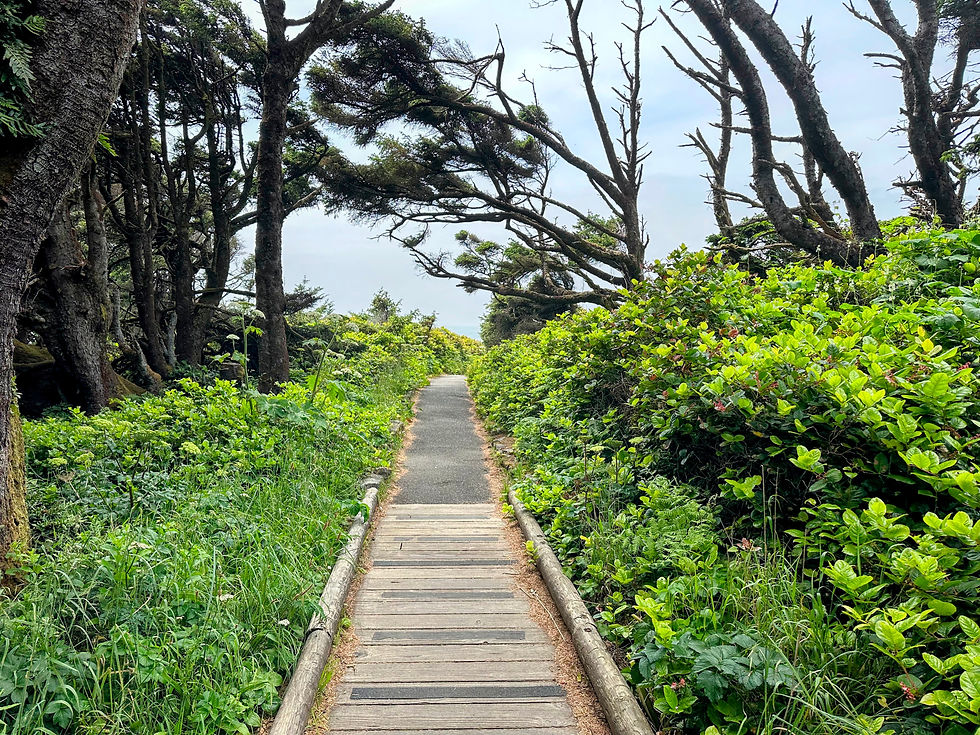
burning in the heart that can only be described as peace. And when we reflect back on them we realize that He is known to us. On the Road to Emmaus there was nothing extraordinary about this, a seven and a half mile journey from Jerusalem, an ordinary human could make this trip in a few hours walking on foot. And yet Christ was found here in the ordinary which was a repeated pattern throughout His ministry. Why, then, do we presuppose that the Divine can only be found in the extraordinary?
Throughout this series we will discuss how prayer beads become a companion on this trail so that we can have these experiences. We’ll see that prayer is more about learning to walk with God instead of making sure we say the “right” thing. We’ll see that Christians have always embraced embodied practices to help cultivate an attentive discipleship that lets us, perhaps, say “Abide with us”.
Trailhead: We are Creatures that Learn with our Bodies
Prayer is more than something we think or say; it is a way of living that engages our whole selves. Throughout Scripture and the history of the Church, God has invited His people to worship not only with their minds and hearts but also with their bodies, using tangible practices that help keep their attention fixed on Him. The Anglican Rosary stands within this long tradition, not as a source of spiritual power, but as a simple companion that guides us into a steady rhythm of prayer, Scripture, and presence with Christ. Like pilgrims walking a well-worn path, we are formed one faithful step at a time, learning to return to God, remain attentive to His presence, and be transformed along the journey. At the Trailhead we will explore why embodied prayer matters, how the Church has embraced physical aids throughout its history, and why the Anglican Rosary offers a meaningful path for modern pilgrims seeking to walk more closely with Christ.
Bearing I: God Made Us Embodied Worshippers
One of our greatest blessings, and some might also say our greatest affliction, is our bodies. There is so much wonder and amazement that comes just in the creation of mankind. As recorded in the Book of Genesis, Chapter Two, verse seven:
And the LORD God formed man of the dust of the ground, and breathed into his nostrils the breath of life; and man became a living soul.
In this union we find in humanity a twofold nature, a material nature and a spiritual one, and it is through this twofold nature that we best travel the path of discipleship. We are embodied worshippers because we are embodied souls.
Physical habits and practices reinforce spiritual realities. Throughout the scriptures we find faithful individuals regularly joining physical actions with spiritual devotions. Saint Paul in his epistle to the Romans said:
12 1 I beseech you therefore, brethren, by the mercies of God, that ye present your bodies a living sacrifice, holy, acceptable unto God, which is your reasonable service.
Our bodies are to become a living sacrifice. They become a sacrifice by using them as part of our worship of God. King David understood this when he wrote what would become Psalms Ninety-Five, in verse six:
6 O come, let us worship and bow down: let us kneel before the Lord our maker.
We are to bow down in our worship, kneeling before our maker. We use our entire body in our worship of God. We see this time and time again in worship practices throughout the world; kneeling, lifting hands, fasting, anointing, sharing bread and wine are all physical practices that reinforce spiritual realities. These physical habits and practices reinforce the spiritual realities because we are embodied souls who desire to worship our Creator. Our prayers are no different.

Bearing II: The Church Has Always Used Tangible Reminders
Repeated prayers have always been a rhythm of worship. Throughout Judaism we find repetition building a rhythm of worship that sustained faith over the course of millenia. This practice continued into the early Church as the movement of Christ’s “Way” began to merge practices of traditional Judaism with the new practices of “The Way”.
As practices and traditions merged, new ones also emerged. One practice that grew from repetitive prayers was the utilization of prayer ropes and beads. Early Christians wanted to fulfill the biblical call of praying unceasing utilized two different means of meeting this expectation: 1) they utilized short, repeated prayers and 2) a physical component to keep track of the number of prayers said and to keep the mind from wandering. Saint Paul the Simple was said to keep three hundred pebbles on his lap, dropping one each time he started the next prayer. Others would tie knots into a length of rope and would move to the next knot at the start of each prayer. These practices gave way to traditions such as the prayer ropes that we find in orthodox christian traditions and prayer beads such as the rosary that we find in the West. In fact, the word bead comes from the old English word “bede” which means “prayer”. It is fun to think that linguistically “prayer beads” is redundant.
Whether pebbles laying in your lap, a rope full of knots, or a round of ornate beads all serve as tools to guide our attention during prayer practices. There is nothing within any of these forms that are imbued with spiritual or magical power. In fact they are not even a requirement for faithful prayer rather they support our practice. This is what has allowed us to have so many variations, from pebbles to prayer ropes the form changes slightly but the practice of embodied prayer remains. The Anglican Rosary is one more form within this tradition.
As a relatively new form of prayer beads within the larger tradition, the Anglican Rosary developed in the late twentieth century as a devotional aid rooted in the Anglican tradition. Being so new is a strength rather than a weakness though. Without centuries of traditions it is a malleable form of prayer practice that can be utilized to strengthen and invigorate prayer in a myriad of ways, not just within the confines of the Anglican tradition.
Bearing III: Prayer is a Pilgrim’s Path

Pilgrimage is an important act in many faith traditions. The secret about pilgrimage though is the fact
that it really isn’t about the destination but rather it is about being changed along the way. Pilgrimage isn’t a vacation to see a neat, historical site connected to one’s faith but rather the path taken to deeply connect to one’s faith. Pilgrimage was an important idea within the Celtic cultures context of Christianity.
Life itself became the pilgrimage. Yes, there were those who took this to extremes, those individuals who practiced green or white martyrdom, but they were not common practices for everyday individuals just trying to get through life faithfully. Rather, within the Celtic culture daily life was sacred, every moment was divine. This built out of the idea that creation itself was sacred and was a witness to God’s goodness. If creation itself is sacred then every single day we have is a pilgrimage to a holy space.
Many practices and traditions, therefore, became part of the pilgrimage. They were practices that illuminated the path that they, and us, are walking. On every journey there includes times of wandering when we are called to return to the path. Prayer is one of those practices that slow those wandering and each step that we take on this path builds trust, patience, and attentiveness. The Anglican Rosary, a pilgrim’s tool, offers a repeatable path that gently shapes these virtues over time.
Taking the First Step:
Every journey begins with a single step, and the journey of prayer begins with the simple decision to be present before God. We are embodied souls, created to worship with our whole selves, and throughout Scripture and the life of the Church, physical practices have helped believers cultivate hearts that are attentive to God's presence. The Anglican Rosary stands within this long tradition as a humble companion for the pilgrim, using the movement of our hands, the rhythm of repeated prayers, and the truth of God's Word to draw our wandering hearts back to Christ. Like every faithful pilgrimage, its purpose is not merely to reach the end of a set of prayers but to be transformed along the way. As you begin this trail, remember that these beads are not the destination—they are simply a guide along the path, inviting you to take one faithful step after another as you learn to return to God, worship Him more deeply, and follow Christ with renewed attentiveness each day.
Trail Marker I: The Trail of Return, Worship, Go

Every trail needs a map, not because the destination is uncertain, but because travelers are prone to
wander. The same is true of the Christian life. We do not grow through isolated moments of inspiration but through a faithful rhythm of returning to Christ, worshiping Him with our whole lives, and going into the world as His disciples. This rhythm forms the heart of the Thin Place Trails Rule of Life and serves as the guiding path for every trail guide in this series. The Anglican Rosary is more than a collection of prayers arranged on a strand of beads; it is a companion that gently leads us through this rhythm again and again. Each circuit of the beads becomes a small pilgrimage—a reminder that God's grace always welcomes us back, that worship reorients our hearts toward Him, and that every encounter with Christ sends us back into the ordinary places of life to love God and serve our neighbors. As we walk this trail together, the beads become markers along the path, helping us live a life that continually returns, faithfully worships, and joyfully goes wherever Christ leads.
Cairn I: Return
As we look at the Anglican Rosary, as well as the Rosary itself, Prayer Ropes, etc, the first thing that hopefully sticks out is the fact that they make a circle. By following the path of the prayer beads we inherently must return to where we started. This is the first principle of the Thin Place Trail. The calling that we hear is to return to our home. We see this in the epistle to the Hebrews, Chapter Eleven, verses thirteen through sixteen:
13 These all died in faith, not having received the promises, but having seen them afar off, and were persuaded of them, and embraced them, and confessed that they were strangers and pilgrims on the earth. 14 For they that say such things declare plainly that they seek a country. 15 And truly, if they had been mindful of that country from whence they came out, they might have had opportunity to have returned. 16 But now they desire a better country, that is, an heavenly: wherefore God is not ashamed to be called their God: for he hath prepared for them a city.
Prior to this section of verses we are given an account of many early fathers and mothers, from Abel to Abraham, Isaac and Jacob, and we culminate with the idea that they all died in faith but had not received the promise, because of this they were pilgrims seeking that heavenly country. So it is with us, we are always seeking to return to that heavenly country that our soul knows.
We are always called from our wanderings, returning whenever we are adrift. It takes effort to answer that call to return and that effort is always preceded by grace. It is God who calls us to return and He gives us what we need in order to make it back. Prayer is one of those acts that actually begins with God’s invitation to return. He is invested in our pilgrimage and desires our return.
Cairn II: Worship

Another piece of the Anglican Rosary that calls our attention is the Cross, a symbol of One who deserves our adoration and worship. This is the second principle of the Thin Place Trail. Once we have returned we are called to Worship. Worship is not a demand placed upon us by an outside force, rather it is a demand placed upon ourselves as we reshape our lives in the image of Christ. It is an outpouring of a reshaped love. Many times we think of Worship as participating in a Sunday gathering where we go to Church, worship, and then go home. Worship extends beyond the church walls and into our daily life. To worship is to show profound honor, extreme love, and deep reverence, worship is not demanded of us by God but is an outpouring from our soul for who God is and what He has done. Worship does not begin and end in the pews of the Church, it begins as we reshape our love towards God. In every step we take, in every action must show an extreme love for He who has shown us such an extreme love.
Prayer helps us reshape this love. Too often we treat prayer as a wishlist, a Christmas list written by a child who does not understand what Christmas is truly all about and who Santa Claus really is. But really, prayer is so much more than that! Saint John Vianney said “prayer is nothing else than union with God.” He also tells a story of a parishioner who said that in his prayers “I don’t say anything. I look at Him and He looks at me.” Both of these show us the transcendent union that prayer can create, it is an intimate worship. And prayer beads can help cultivate in us a steady attention to a God that has a steady attention upon us.
Cairn III: Go
There comes a moment in every round of the beads when our fingers leave the cross. This is not the end of prayer but its fulfillment. Just as Christ withdrew to lonely places to pray before returning to the crowds, we too lay the beads aside so that what has been cultivated in prayer may bear fruit in our daily lives. The rosary is meant to be held for a time so that Christ's love may be carried everywhere.
This is the last principle on the Thin PLace Trail, to Go. Eventually the prayer cycle ends and we put the rosary down. But we don’t JUST put the rosary down but rather we put them down and we GO. Prayer is meant to overflow into love of our neighbors, we are sent to go and be with our neighbors. Every time we pray we leave carrying Christ’s presence with us into the ordinary places of the world. The journey always moves outward in service and witness.
Prayer resets our feet in the correct direction of faithful pilgrimage and as it does so it also corrects our desires and our passions. Instead of desires and passions being inwardly manifested they become outward manifestations of a love that is beyond us, a love that we are unworthy of and that is given to us freely. As we begin to feel, and inadequately understand, this love it is the only natural course to share that love with others.
The place where you next encounter Christ may not be another quiet prayer corner. It may be the office, the classroom, the kitchen table, or the grocery store. The pilgrim does not leave the sacred behind when prayer ends. Instead, prayer teaches the pilgrim to discover that Christ is already present in the ordinary places where He sends us.
The Rhythm of the Trail:

This is why we walk the beads. We do not walk them simply to complete a set of prayers, nor to
master a particular devotion. We walk them because, over time, they teach us the rhythm of the Gospel itself. Again and again they call us to return to the Father who welcomes us, to worship the Son who transforms us, and to go in the power of the Holy Spirit into the ordinary places of life. In this way, the Anglican Rosary becomes not merely something we pray, but a trail that slowly forms us into pilgrims who walk with Christ every day.
Overlook I: Seeing the Trail Ahead

Just as the Rosary is a cycle of prayer, so too is our formation. Our formation into the image of Christ is responding to the call to Return, rightful Worship and then Go. But it doesn’t end there, as we Go we inherently hear again the call to Return, and the cycle continues over and over again throughout our lives. The prayer beads become a companion throughout this formation, through every season of life.
Standing Stone I: Walking the Circle
As discussed the shape of the rosary itself is a teaching tool of the rhythm of returning, worshipping, and going. For this exercise or practice you will need a Rosary, an image of one will work as well.
Hold the cross in your hand for a few moments or focus your attention on the image of the Cross. Take a slow breath and remember that you are not beginning this journey alone. Before you ever sought God, He sought you. Before you decided to pray, He had already invited you into His presence.
Now begin to move around the beads, move up the stem to the circle of beads. Simply focus on the movement. Each bead reminds you that every journey eventually comes back to its beginning. As you move to each bead, pause and just be. If your thoughts wander…return. If distractions come…return. If you remember your failure…return. If you become discouraged…return. Do not fight the wandering, simply return.
As you make your way back to the cross, pause. Remain silent for several breaths. Simply be with God. Remember the words of the old parishioner, “I look at Him, and He looks at me.”
Go around the circle as many times as you want. You could end after the first cycle or you could go around again and again. Each time you do repeat the previous two exercises.
Eventually you will feel complete, that it is time to stop praying. When that happens resist the quick temptation to immediately put the beads away. Instead ask, “Lord, where are You sending me today?” And then wait quietly for a space of time, letting every pull and answer wash over you. Finally, put the beads away. Your prayer has not ended but the pilgrimage continues.
Campfire Reflection: The First Step is Simply to Begin
Thank you for sticking around the first post of a series that looks at utilizing the Anglican Rosary as a tool through this pilgrimage. Just as a pilgrim stands at the beginning of the road, so too do we stand ready to engage in our own prayer pilgrimage. Perhaps the path is shrouded in mist and it’s difficult to know where it leads but for us the next few steps are illuminated. We just need to take the first step. We hope that you will come back and join us on the journey. Until then, we’ll leave you with the following reflection questions:
Where do you most long to experience God's presence today?
When has an ordinary place unexpectedly become sacred for you?
What rhythms already help you slow down and notice God?
What might it look like to approach prayer as a walk rather than a task?

The Christian life is not measured by how perfectly we pray, but by how faithfully we continue to walk with Christ. There will be days when the path seems clear and days when it disappears beneath the fog, yet the invitation remains the same: return to the One who first called you, worship Him with your whole life, and go into the world bearing His love. The Anglican Rosary is not the journey itself, but a faithful companion that gently guides our feet back to this rhythm again and again. With each circuit of the beads, we rehearse the story of the Gospel—grace calling us home, love transforming our hearts, and Christ sending us into the world as His witnesses. As we continue along the Thin Place Trail, may these simple practices become more than moments of devotion. May they become a way of life, shaping us into pilgrims whose ordinary days are increasingly marked by the extraordinary presence of God.


Comments